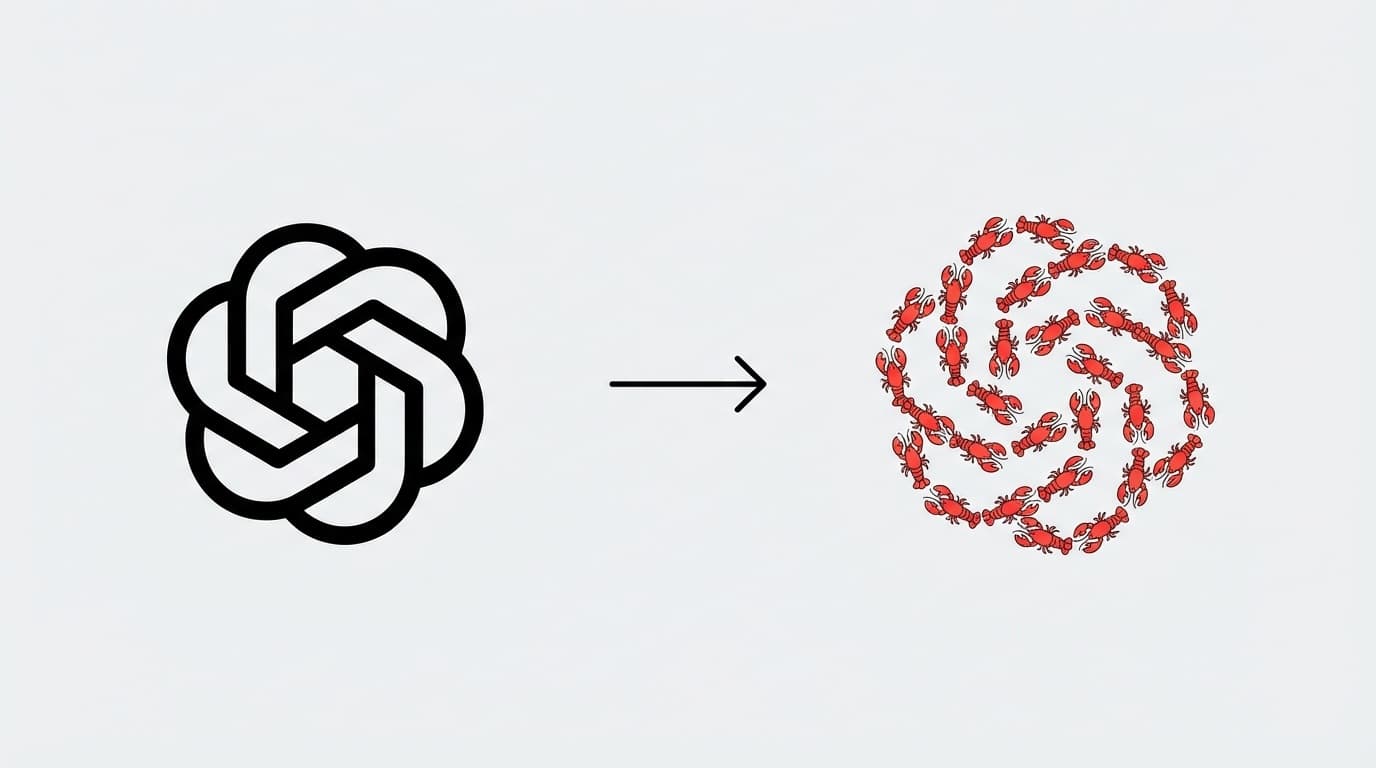
A few days ago, Peter Steinberger, the creator of OpenClaw, announced he's joining OpenAI to work on bringing agents to everyone. His goal: "build an agent that even my mum can use." That's a big deal, but it's not the story. The story is what the product actually looks like.
I know because I've been living with it.
Why I'm Writing This
I've been running OpenClaw on a Mac Mini for three weeks. My agent, Carl, manages my calendar, sends iMessages on my behalf, researches topics while I sleep, monitors my GitHub repos, and drafts emails. He has opinions. He remembers our conversations. He works while my laptop is closed.
I've been showing what Carl can do to my friends and family. My mom uses him for her therapy practice. My sister got legal research delivered to her phone at 9am on a Sunday. My friends in our group chat interact with him like he's just another person in the room.
Every single one of them has asked the same question: "How do I get my own?"
The honest answer today is you can't. Not easily. OpenClaw requires a Mac Mini, command-line setup, API keys, and more patience than most people have. It's powerful, but it's not for everyone.
That's exactly what OpenAI is about to fix.
The Product: Your Always-On Personal Agent
It'll be a new tier within your ChatGPT subscription, and it'll be very different from the ChatGPT you use today.
You'll still have a chat interface. You need somewhere to talk to it. But this isn't a chatbot waiting for you to type a question. It's an always-on agent that works in the background, takes actions on your behalf, and reaches out to you when something needs attention.
App integrations, lots of them. Gmail, Google Drive, Calendar, Figma, Canva, GitHub, Notion, and new integrations added constantly. You connect the apps you use and your agent gets the same access you'd give a trusted executive assistant. It reads your email and flags what matters. It monitors your calendar and resolves conflicts. It drafts documents based on templates you've used before. You grant permissions one at a time, the same way you approve app permissions on your phone.
Multi-channel access. You won't be stuck in the ChatGPT app. Your agent will be reachable through WhatsApp, iMessage, Line, or whatever messaging platform you already live on. Text your agent the way you'd text a friend. It texts you back when something needs your attention. No app to open, no browser tab to keep alive. There's an open question: will OpenAI keep everything in-house, or open up to third-party messaging? My bet is both. A polished first-party experience in ChatGPT, plus messaging integrations for people who want to reach their agent where they already are.
Agentic browsing. It can go on the internet for you. "Find me the best-reviewed sushi restaurants near my hotel in Tokyo that are open Tuesday night and make a reservation." It researches, evaluates options, and comes back with a recommendation or a completed booking.
Its own phone number. Your agent gets a real phone number. It can call restaurants to make reservations, call airlines to rebook your flight, or sit on hold with customer service for two hours so you don't have to. When someone picks up, your agent handles the conversation. You get a summary after. This is also where Sweetpea, OpenAI's rumored wearable device, fits in: an always-listening companion that connects you to your agent by voice, anywhere.
Scheduled automation. "Every morning at 7am, check my calendar and send me a summary." "Remind me to follow up with Daniel if he hasn't replied by Thursday." "Every time I get an email from my accountant, forward it to my bookkeeper and add a calendar event for the due date." You describe what you want to happen and when. It just runs.
So how is this different from ChatGPT today? ChatGPT is reactive. You ask, it answers. This is proactive. It works while you sleep, monitors things you care about, takes actions without being prompted, and reaches you on whatever platform you're already using. It's the difference between a search engine and an employee.
I know this is real because I already have it. The difference is that mine took three weeks of tinkering and a dedicated computer. OpenAI's version will take a credit card and five minutes.
Agent-to-agent coordination. When everyone has a personal agent, the agents start talking to each other. Your agent coordinates with your coworker's agent to find a meeting time that works for both calendars. Your agent talks to a contractor's agent to negotiate terms on a project. Your agent checks in with your mom's agent to get context on what's happening with family plans this weekend.
"My people will talk to your people" used to be something only executives said. Soon it'll be true for everyone. Your agent is your people.
What will it cost? Expect $100-200/month. You're paying for always-on compute, storage, and 24/7 availability. Real infrastructure, not just API calls.
What This Means for Businesses
The consumer product is a personal assistant. The enterprise version is a digital worker. Not a chatbot that answers HR questions. An emulated employee that plugs into your company's infrastructure.
Picture this: an agent with access to Slack, reading every channel it's assigned to. Access to your company's internal documents, wikis, and knowledge bases. Posting updates, answering questions, flagging issues in internal channels. Making commits and pull requests to your code repositories. Sitting in your meetings, taking notes, summarizing action items, and following up on them the next day.
It's not replacing your team. It's giving every team a tireless junior colleague who never forgets anything, never drops a follow-up, and works nights and weekends without complaining. An engineering team gets an agent that monitors CI/CD pipelines and fixes broken builds. A sales team gets one that researches prospects and drafts personalized outreach. A support team gets one that triages tickets and resolves the routine ones on its own.
OpenAI's Frontier platform, launched earlier this year, already treats agents like employees. They get onboarding. They get feedback loops. They get defined identities and permissions. The enterprise agent product is the natural next step: not a tool you use, but a teammate you manage.
At $500+/seat, maybe significantly more for specialized roles, CTOs will do the math and realize they're getting a worker that costs a fraction of a human one and runs 24/7. The consumer product might be $100-200/month. The enterprise product, with compliance, audit logs, SSO, and deeper integrations, will cost a lot more. Adoption will be fast.
What It Won't Give You (And Why OpenClaw Still Matters)
OpenAI's product will be great for most people. But there are real trade-offs, and they're the same reasons OpenClaw isn't going anywhere.
Model choice. OpenAI's product runs OpenAI models. That's it. With OpenClaw, I run Opus 4.6 for most things, Codex 5.3 for coding, Kimi 2.5 for simple tasks. I pick the best model for the job and keep costs reasonable. If someone ships something better next month, I switch. OpenAI users can't.
Customization. OpenClaw lets me write custom skills, hook into any API, run arbitrary code, and change every aspect of how my agent behaves. OpenAI will give you a polished settings page with toggles. You'll get "choose your agent's personality." You won't get "write a Python script that scrapes apartment listings and cross-references them with your commute time."
Transparency. I can read every log, every tool call, every decision Carl makes. I can see why he did something and change the behavior. OpenAI's product will be a black box with a nice UI. When something goes wrong, you'll submit a support ticket instead of fixing it yourself.
Data ownership. My data lives on my machine. Credentials, conversations, memory files, all local. OpenAI's version means everything lives on their servers. Every email, every message, every credential you connect. You're trusting a corporation with the keys to your digital life.
Vendor independence. Once your agent has six months of context, connected accounts, and learned preferences, you're locked in. Switching costs are enormous by design. OpenClaw has no lock-in because you own everything.
Power. The consumer product will be sandboxed for safety. No shell access, no arbitrary code execution. That's the right call for most people, but it means OpenAI's agent will always be a subset of what a self-hosted agent can do.
Community. 180,000+ GitHub stars means thousands of developers building skills, fixing bugs, and pushing OpenClaw forward every day. OpenAI moves at OpenAI's pace. OpenClaw moves at the speed of open source.
OpenAI is building the Toyota Camry. Reliable, accessible, does what 90% of people need. OpenClaw is the kit car. Unlimited power, total customization, but you need to know what you're doing. Steinberger built the open-source proof of concept, went to OpenAI to build the mass-market version, and the open-source version keeps running and improving without him. Everyone wins.
What to Do About This
If you're a regular person: Wait. This ships H2 2026 at the earliest. When it arrives, it'll be the easiest way to get a personal AI agent. For most people, the trade-offs are worth the convenience.
If you're technical and impatient: Set up OpenClaw now. It's what I did, and three weeks later I can't imagine going back. The setup cost is real but the capability is unmatched.
If you're running a business: Start piloting agent workflows now. The companies experimenting today will have a 12-month head start on everyone who waits for the polished version.
If you're building in this space: Agent infrastructure is about to become the most important market in tech. OpenAI is making their move. So is Anthropic. The window for new entrants is closing fast.