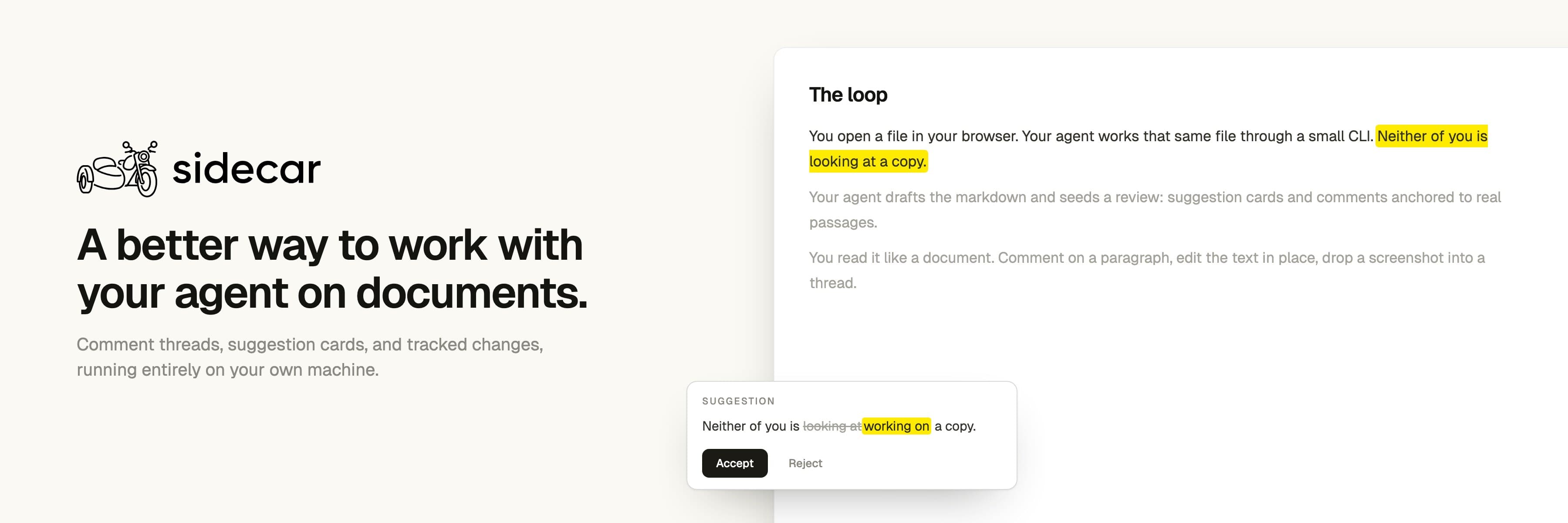
The chat window was never a good place to work on a document with your agent. People solved this for themselves years ago. Google Docs and Notion give you comment threads, suggestions, and version history. Your agent gets none of it. It reaches your document through an MCP server or an API, so it sees a narrow slice of the file and has to make a network request to change anything, or to find out what you changed.
sidecar fixes that. Instead of bringing your agent to your document, it brings the document to your agent. It wraps your file in a rich-text markdown editor with comment threads, suggestion cards, and version history, and your agent lives inside it, so you can talk to it while you edit. Every comment and every thread lives on your own disk.
The loop
Let's say you're working on a LinkedIn post with your agent, and you want to make edits.
- You ask your agent to open the post in sidecar.
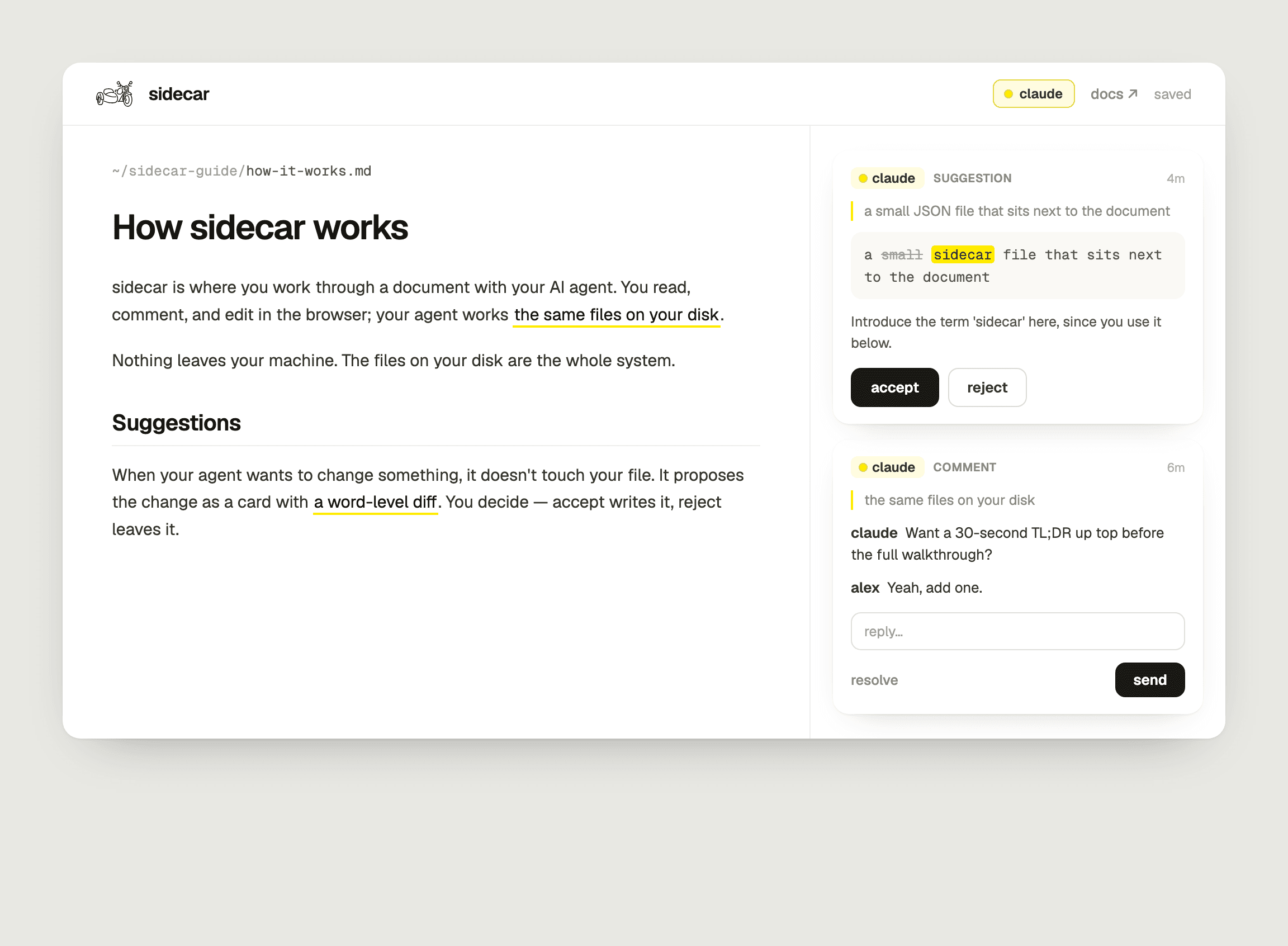
- You read it like a document. Comment on a paragraph, edit the text in place, drop a screenshot into a thread.
- Your agent answers while you are still reading. It replies inside your threads, proposing rewrites as cards you accept or reject.
- When you're done, tell your agent you're finished.
Features
- Rich-text markdown. Read and edit the document as a rendered page instead of raw markdown. Your edits write the real file.
- Comments, threads, and suggestions. Comment on any passage. Your agent proposes rewrites as cards with a word-level diff, and you accept or reject each one.
- Upload images. Paste a screenshot into a thread and your agent can open it. It can attach images back the same way.
- Works on your phone. Start a review at your desk and finish it from the couch, over your own private network.
- An always-on agent. Your agent watches the review and answers in your threads while you are still reading.
- Diagrams you can comment on. A
```flowfence renders as a diagram, and clicking a box opens a thread on that step. - Git is your undo. Untouched text stays byte-identical, so
git diffshows only what you changed.
What's under the hood?
Two pieces: a small Node server and a single HTML page. No build step, no database, no account. Your comments and the pending suggestions live in a plain JSON file beside the document, so the filesystem does the syncing and git keeps the history.
Any agent with a shell can drive it. Claude Code, Cursor, Codex: one CLI, no plugin, no API key.
It's MIT licensed, runs entirely on your machine with no uploads and no network requests, and needs Node 20 or newer.
Getting started
One line, run once, in the project where you keep your drafts:
npx skills add smithavt14/sidecar
Then tell your agent "review draft.md in sidecar." It fetches the tool, starts the server, and opens the review in your browser.
It's free, and the whole thing is on GitHub. Read it, clone it, change it.
View the source