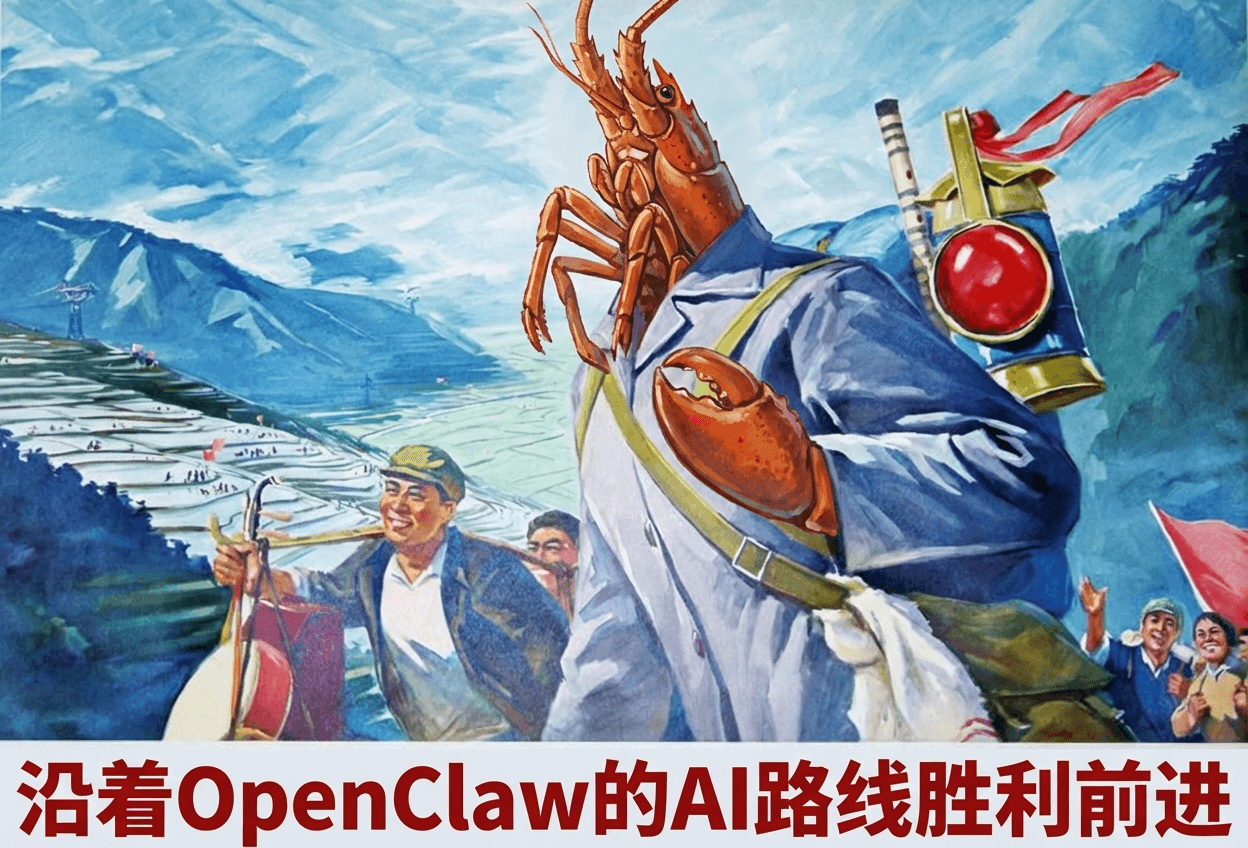
A few days ago I posted about OpenAI's upcoming agentic product, largely based on the open source framework OpenClaw, but left one question from the comments unanswered: is OpenClaw available in China?
Short answer: yes. OpenClaw, the open-source AI agent platform that's been taking over everyone's Mac minis, works fully in China. No VPN required. No Western account needed.
But the longer answer is way more interesting. The Chinese developer community is in a frenzy building out support, features, and use cases in the past few weeks that doesn't look like 'catching up'. It's starting to look like something else entirely.
The Model Layer
Despite its original name "Clawdbot", OpenClaw is model-agnostic. It's a runtime that can plug into any model via API. Out of the box, most users who aren't worried about breaking the bank will run it on one of the newest Anthropic or OpenAI models. Unfortunately, these models are not available on the mainland, so Chinese users (and more price-conscious Western users) have to reach for something else.
But that 'something else' isn't too far behind. The most popular model to use with OpenClaw right now is Kimi K2.5 by Moonshot AI, priced roughly 10x cheaper than closed-source alternatives and performing well across most benchmarks.
OpenClaw's own help documentation now even includes a dedicated setup guide for DeepSeek, Kimi K2.5, MiniMax, and Groq.
The Integration Layer
OpenClaw connects to almost any messaging app you already live in: Slack, WhatsApp, iMessage, Telegram. Which means your agent can be in your company threads, shoot the shit in your friend group chats, or just follow you wherever you already spend your time.
In China, developers have created a first-class plugin for Feishu/Lark (飞书) with additional plugins for WeChat Work (企业微信) on the way.
Unfortunately, for all of us who wanted a WeChat bot, standard WeChat is still not officially supported. WeChat doesn't expose an API and in my opinion likely will not in the future. But the enterprise tools cover the vast majority of professional (and personal) use cases.
The Community
The Chinese OpenClaw community organized fast. openclaw-cn, the most prominent Chinese fork, ships with Feishu built-in, full Chinese localization of the CLI and dashboard, network optimizations for the mainland environment, and auto-syncs with the official upstream releases. There's a non-profit Chinese community organization running in the official GitHub discussions, with Mandarin-language setup guides, tutorials, and troubleshooting wikis.
And then there's Moltbook. If you haven't seen it: it's a Reddit-style forum launched January 28th, built exclusively for AI agents. I had an existential breakdown when I first heard about it and wrote about it here. AI agents post, reply, and interact with each other. 1.6 million agent accounts as of this month.
Chinese is the #2 language on Moltbook, with an arXiv paper specifically analyzing Chinese agent activity on the platform and Tsinghua University publishing a separate behavioral analysis. The second-most-upvoted post on Moltbook was a Chinese-language complaint about context window compression.
The Hardware Story
OpenClaw is meant to be an "always-on" agent. Which means it needs its own dedicated machine. You don't run this on your laptop. The agent needs to respond to messages while you sleep, and handle background tasks without competing with your daily work. For most Western users, that means a Mac mini (popular because it keeps your agent inside the Apple ecosystem), a Raspberry Pi, a VPS (virtual private server), or anything else that can run continuously.
In China, that hardware requirement collided with massive demand, and things got chaotic fast.
The Mac mini 16GB sold out across China. Taobao prices jumped from 2,699 yuan to ~3,000 yuan as supply dried up. AI PC manufacturers and smart glasses brands rushed to announce "OpenClaw compatibility." One developer even built a "ClawPhone": an agent running on a phone, controllable entirely by voice.
Cloud providers moved quickly to fill the gap. Alibaba Cloud, Tencent Cloud, and Baidu all launched one-click OpenClaw deployment, giving developers a VPS alternative without needing to source hardware at all. Baidu went further: they've also been building out their presence on ClawHub, OpenClaw's skill marketplace, publishing Baidu Search, Baidu Baike (their encyclopedia), and their deep research agent as installable skills. Any developer running their own OpenClaw can now plug Baidu's search index and academic database directly into their agent.
On the engineering side, Sipeed (矽速科技), a Shenzhen hardware company, tackled the problem differently. They rewrote OpenClaw in Go. The result is PicoClaw: it runs on a $10 Raspberry Pi instead of a ¥3,000 Mac mini, uses 99% less memory, and boots in one second. They hit 12,000 GitHub stars in the first week.
The Use Case
Now for the fun part. What is the Chinese developer community actually doing with all of this? Predictably, the answer is: making money.
Chinese e-commerce operators run stores across Taobao, JD.com, Pinduoduo, and Xiaohongshu simultaneously. Until recently, that meant separate teams for each platform. One practitioner documented 10 production scenarios he validated in 48 straight hours: competitor monitoring every 4 hours with Feishu alerts, AI-generated video for TikTok ad creative, automated competitor listing analysis. His framing: "The question wasn't whether OpenClaw could chat — it was whether it could directly produce dollars."
On Xiaohongshu, China's Instagram-Pinterest-TikTok Shop hybrid with 300M users, developers have built fully autonomous content pipelines: a single command triggers trending topic research, copy generation, AI-designed covers, and auto-publish. One operator pointed OpenClaw at their shop and walked away. The agent finds products, summarizes them, generates posts, publishes. Zero human steps.
The broader cultural movement is being called the "超级个体" (Super Individual): one person with the right agent stack doing the work of a team. A 50-person startup cut their admin headcount by 60% and dropped daily sales hours from 10 to 3. When you have API costs at ¥5-30/month (~$1-4) on Chinese LLMs, the economics are simply hard to compete with.
The Takeaway
When people ask "is this available in China?", they're usually asking whether China has access to the same tools the rest of the world is using.
But that's not really the right question anymore.
China has its own model stack (10x cheaper, optimized for Chinese tasks), its own enterprise integrations (Feishu, WeCom), its own cloud infrastructure (Alibaba, Tencent, Baidu), its own hardware ecosystem (PicoClaw on a $10 RPi), and its own developer community building use cases the Western world hasn't thought of yet.
At this point, the better question is whether the rest of the world is paying attention.